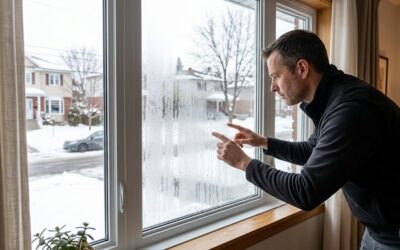
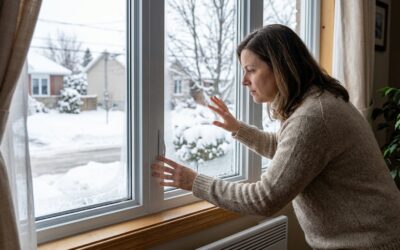
It's -20°C in Montreal this morning. You open your curtains and discover a layer of ice or frost at the bottom of your windows, inside the house itself. Even worse, a puddle forms on the sill when the sun hits it.
Are your windows poorly insulated? Is your house too damp? Or is this a sign that your The thermos is unsealed. ?
In this quick diagnostic guide, we will help you identify the exact cause of this common Quebec winter problem and give you solutions (which do not always require replacing the entire window!).
💡 Did you know?
Cold air can hold far less moisture than warm air. This is why condensation always forms on the coldest surfaces in a room: your windows. If your windows are efficient, the inner surface should remain warm enough to prevent this.
Why does ice form inside?
Simply put: ice forms when the warm, humid air in your home comes into contact with a glass surface that has become too cold. It's the same principle as a can of cold soda that "sweats" in the summer, but in winter: the "sweat" freezes.
However, there are two possible scenarios. One is easy to resolve, the other requires intervention.
The Quick Test: Humidity Problem vs. Broken Thermos
Take a close look at your windows and compare them with this table to determine if you need to call an expert.
| Symptoms | Probable Cause | Solution |
|---|---|---|
| Ice only at the bottom of the window (less than 2 cm) | High ambient humidity | Lower the humidity, open the curtains to let the air circulate. |
| Fog or ice BETWEEN the two panes of glass | Thermos unsealed (Broken) | Glass replacement required. |
| Ice in the center of the window or excessive frost everywhere | Loss of insulating gas (Argon) | The glass no longer blocks the cold. Replacement required. |
| Sensation of a direct cold draft | Worn weatherproofing or Thermos finished | Check the seals or replace the thermos. |
Scenario 1: It's "just" humidity
If you cook a lot, take hot showers, and have many plants, your humidity level may be above 40%. If it's very cold outside, it's normal to have a little condensation at the bottom of the window. Try running your air exchanger.
Scenario 2: Your Thermos is an "Ice Cube" (The real problem)
If your humidity level is normal (30-35% TPH) but the glass feels icy to the touch in the center, that's a bad sign. This means that Argon gas (which acts as insulation between your windows) has escaped.
Your window no longer has any thermal protection. The cold outside passes through the glass without resistance, turning your inner pane into a block of ice.
A fogged or frosted window in the center often indicates a total loss of insulation.
The invisible danger: Why not ignore the ice?
One might be tempted to wipe up the water and wait until spring. This is a mistake for two main reasons:
1. The Heating Bill 💸
A window with a broken thermal insulation system is a thermal hole. You're literally heating the outside. Read our article on the impact of windows on your bills..
2. Black Mold 🍄
When the ice melts, water seeps into the frame (especially if it's made of wood) and into your walls. This creates black mold, which is toxic to your family's respiratory health.
The Economical Solution: Change the Thermos, Not the Window
Many homeowners in Montreal and Laval mistakenly believe that windows cannot be repaired in winter. That's a myth!
"Replacing a thermos in winter is a quick fix that doesn't cool your home. In less than 20 minutes, the hole is sealed and you immediately gain comfort."
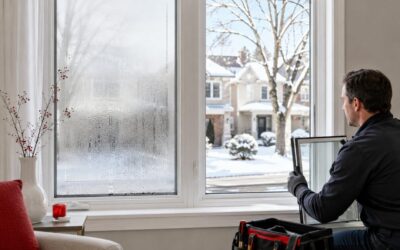
If your frame (PVC or wood) is still in good condition, we can perform a thermos replacement.
How does it work?
- We've come to take the exact measurements.
- We manufacture new factory-sealed double (or triple) glazing with new Argon gas and a high-performance Low-E film.
- We come to your home, remove the old broken glass and install the new one.
Installation takes approximately 20 minutes per window. Your house won't freeze, and you solve the ice problem permanently for a fraction of the price of a new window.